There is no single “best” alloy among Incoloy 800, 840 and 825 for every heating element. The right choice depends primarily on what the heater sheath must resist.
For many tubular heating element projects:
- Alloy 840 is a logical material to review when the requirement is a purpose-developed heating element sheath alloy, particularly for seam-welded tubing.
- Alloy 800 is widely used where the heater requires a broader combination of elevated-temperature strength, oxidation resistance, corrosion resistance and fabrication capability.
- Alloy 825 is usually a more corrosion-driven choice, particularly when the sheath is exposed to acidic or chemically aggressive process media.
The important point for a heater manufacturer is that 840 is not simply a lower-grade 800, and 825 is not simply a higher-grade 800. They were developed with different alloy balances and different service priorities.
Incoloy 800 vs 840 vs 825: Quick Comparison for Heating Element Buyers
| Item | Alloy 800 | Alloy 840 | Alloy 825 |
|---|---|---|---|
| Common designation | UNS N08800 / W.Nr. 1.4876 | W.Nr. 1.4847 | UNS N08825 / W.Nr. 2.4858 |
| Approx. nominal chemistry | Fe 47, Ni 31, Cr 21 | Fe 60, Ni 19.5, Cr 19.5 | Ni 39, Fe 35, Cr 21, Mo 3, Cu 2, Ti 0.8 |
| Main selection direction | Heat resistance + oxidation resistance + general corrosion resistance | Purpose-developed heating element sheath alloy, especially welded tube | Corrosion resistance in more demanding chemical environments |
| Heating element relevance | Widely used heater sheath material | Specifically developed for electrical heating element sheath tubing | Used when corrosion of the sheath becomes a major design concern |
| Nickel content | Higher than 840 | Lower than 800 | Highest of the three on a nominal basis |
| Mo / Cu addition | No significant Mo/Cu alloying | No significant Mo/Cu alloying | Contains Mo and Cu for corrosion resistance |
| Typical buyer question | “Do I need a more heat-resistant sheath than stainless steel?” | “Can I use a heater-specific welded sheath alloy?” | “Is the heated liquid too corrosive for 800/840?” |
The nominal compositions above are useful for understanding the design intent of the three alloys, but the actual purchase specification and chemical limits should be confirmed against the required material standard or customer specification.
The First Question Should Be: What Is the Heater Actually Heating?
A purchasing engineer should not start by asking:
“Is 800, 840 or 825 better?”
Start with:
“What medium is in contact with the sheath, and what is the actual sheath operating condition?”
This immediately changes the selection logic.
A heater used in:
- clean or treated water;
- hard water;
- steam;
- air;
- oil;
- alkaline cleaning solution;
- acidic process liquid;
- chemical bath;
- food-processing liquid;
may require very different sheath materials even when the heater power and physical dimensions look similar.
This is particularly important because the temperature of the medium is not necessarily the temperature of the heater sheath.
A water heater may operate with relatively moderate bulk water temperature while the metal sheath is significantly hotter. Scale, poor flow, localized boiling, high watt density or partial dry-out can increase sheath temperature further.
For this reason, the buyer should provide both the medium temperature and, where available, the maximum expected sheath temperature or watt density.
Why Alloy 840 Is Different: It Was Developed for Heating Element Sheath Tubing
Among these three alloys, Alloy 840 has the clearest heater-specific historical positioning.
Special Metals describes Alloy 840 as an Fe-Ni-Cr alloy specially developed for seam-welded tubing used for the sheathing of electrical heating elements. Its nominal composition is approximately 60% Fe, 19.5% Ni and 19.5% Cr. VDM likewise lists Alloy 840 / 1.4847 for tubular heating elements and calrod applications.
That makes 840 particularly relevant when a tubular heating element manufacturer is looking for:
- a heater-sheath-specific alloy;
- welded thin-wall tube;
- good fabrication compatibility with tubular heater manufacturing;
- an Fe-Ni-Cr alloy with less nickel than Alloy 800;
- a material already familiar in water-heater, appliance-heater and tubular-element manufacturing.
The lower nickel content can also reduce exposure to nickel raw-material cost compared with higher-nickel alternatives, although the final tube price still depends on strip availability, tube size, wall thickness, quantity, production route and inspection requirements.
Does That Mean Alloy 840 Is Always the Cheapest or Best Heater Tube?
No.
A lower nominal nickel content does not determine the complete heater cost or service life.
A buyer still needs to consider:
- corrosion of the sheath;
- operating temperature;
- thermal cycling;
- scale formation;
- bending and forming;
- weld seam quality;
- tube wall thickness;
- heater reduction or swaging process;
- customer qualification history.
If an existing 800 heater already has established validation data, changing to 840 only for material cost should still be treated as a material-change project rather than an automatic substitution.
When Alloy 800 Makes More Sense
Alloy 800 is a nickel-iron-chromium alloy with nominal nickel around 30-35% and chromium around 19-23%.
It has a broader high-temperature engineering history than 840. Special Metals describes Alloy 800 as a material combining heat resistance, strength and corrosion resistance, with resistance to oxidation, carburization and other high-temperature corrosion mechanisms. It is also specifically listed for electric heating element sheathing.
For a heating element manufacturer, Alloy 800 is therefore commonly worth reviewing when:
- elevated sheath temperature is an important design factor;
- oxidation resistance matters;
- the element operates in air or another elevated-temperature environment;
- the application requires a well-established high-temperature Fe-Ni-Cr alloy;
- the existing heater is already qualified with UNS N08800;
- the buyer needs welded or seamless tube options according to the heater design and purchase specification.
In practice, Alloy 800 is often the balanced high-temperature choice among these three grades.
It is not selected only because it contains more nickel than 840; its overall chemistry and established elevated-temperature behavior are the more relevant engineering reasons.
Do Not Select Alloy 800 from One Temperature Number Alone
A common mistake in heater material selection is to search for:
“Maximum temperature of Incoloy 800”
and then use that number as the heater design limit.
That can be misleading.
Special Metals describes Alloy 800 as usable in certain equipment construction applications up to about 816°C, while its quick-reference guide describes electric-heating-element sheath applications generally below about 650°C. These numbers refer to different design contexts and should not be converted into one universal heater-sheath temperature limit.
For a tubular heating element, the allowable sheath condition also depends on:
- watt density;
- heat transfer to the medium;
- heater geometry;
- local hot spots;
- scale or deposits;
- thermal cycling;
- tube wall thickness;
- internal MgO condition;
- bending and reduction history;
- required service life.
Therefore, the heater designer’s validated sheath-temperature limit should take priority over a generic alloy temperature number.
Alloy 800 Is Not the Same as 800H or 800HT
This is another purchasing issue worth checking carefully.
Alloy 800, 800H and 800HT belong to the same alloy family, but they are not identical material designations.
Special Metals lists:
- Alloy 800 – UNS N08800
- Alloy 800H – UNS N08810
- Alloy 800HT – UNS N08811
800H and 800HT have additional controls involving carbon, grain size and, for 800HT, Al + Ti chemistry intended to support elevated-temperature creep and stress-rupture performance.
For a heater tube purchase order, therefore:
Do not replace N08800 with N08810 or N08811 simply because all three are called “800 series.”
Use the grade approved by the heater drawing, customer specification and validation history.
When Alloy 825 Makes More Sense
Alloy 825 is fundamentally different from 800 and 840.
Its chemistry includes approximately:
- 38-46% nickel;
- 19.5-23.5% chromium;
- 2.5-3.5% molybdenum;
- 1.5-3.0% copper;
- 0.6-1.2% titanium.
The Mo and Cu additions are particularly important because Alloy 825 was designed for resistance to a broader range of corrosive environments, including reducing acid conditions; molybdenum also contributes to resistance against localized corrosion.
For a heating element manufacturer, this means 825 should normally enter the discussion when the problem is not simply heat, but heat plus corrosion.
Typical review situations may include:
- immersion heaters in certain acidic process solutions;
- chemical bath heaters;
- process-liquid heaters where 800 or 840 has shown unacceptable corrosion;
- equipment where localized corrosion of the sheath is a known failure mode;
- applications where the end-user specifically requires UNS N08825.
VDM also identifies Alloy 825 as a tubular heating element / calrod material, while its broader materials positioning is corrosion-resistant rather than primarily heat-resistant.
Is Alloy 825 Therefore “Better” Than 800 or 840?
No.
825 is more highly alloyed for certain corrosion problems, but that does not automatically make it the better choice for a standard water heater or high-temperature dry heater.
If corrosion is not the limiting factor, the additional Mo, Cu and nickel may add material cost without solving the actual heater-design problem.
Conversely, if an 800 or 840 heater sheath is failing because of a particular corrosive process medium, switching to another high-temperature alloy without investigating the corrosion mechanism may also fail.
A Practical Selection Matrix
| Heater Condition | Initial Material Direction | Why |
|---|---|---|
| General tubular heater / water heating | 840 or 800 may be reviewed | Both are established heating element sheath directions |
| Welded thin-wall heater sheath | 840 deserves particular review | 840 was specifically developed for seam-welded electrical heating element sheath tubing |
| Elevated-temperature heater where oxidation / heat resistance is a major factor | 800 may be reviewed first | Broader high-temperature oxidation and strength positioning |
| Existing design already qualified to UNS N08800 | Stay with 800 unless redesign is approved | Existing heater validation may be more important than raw alloy cost |
| Acidic or chemically aggressive process liquid | 825 may be reviewed | Corrosion becomes a primary selection driver |
| Existing 800 / 840 sheath suffering corrosion | Identify failure mechanism, then compare 825 or other alloys | Material change should address the actual corrosion mechanism |
| Severe chloride, mixed acid or highly aggressive chemistry | Do not assume 825 is sufficient | Inconel, Hastelloy, titanium or another direction may require review |
| High thermal cycling or demanding forming | Material + tube manufacturing route must be reviewed together | Ductility, annealing, weld quality, wall thickness and heater process become important |
This table is an initial screening tool only. Actual suitability depends on the heater design, medium, temperature, watt density, corrosion conditions and customer specification.
For Heating Elements, Tube Quality Can Matter as Much as Alloy Name
From a purchasing perspective, specifying “Incoloy 800” or “Alloy 840” is only the beginning.
A tubular heater manufacturer will normally process the tube further through operations such as:
- resistance wire assembly;
- MgO filling;
- reduction or swaging;
- annealing where required;
- bending or forming;
- terminal sealing;
- electrical and thermal testing.
The tube therefore has to survive manufacturing as well as service.
Important incoming-tube requirements may include:
- chemical composition;
- annealed condition;
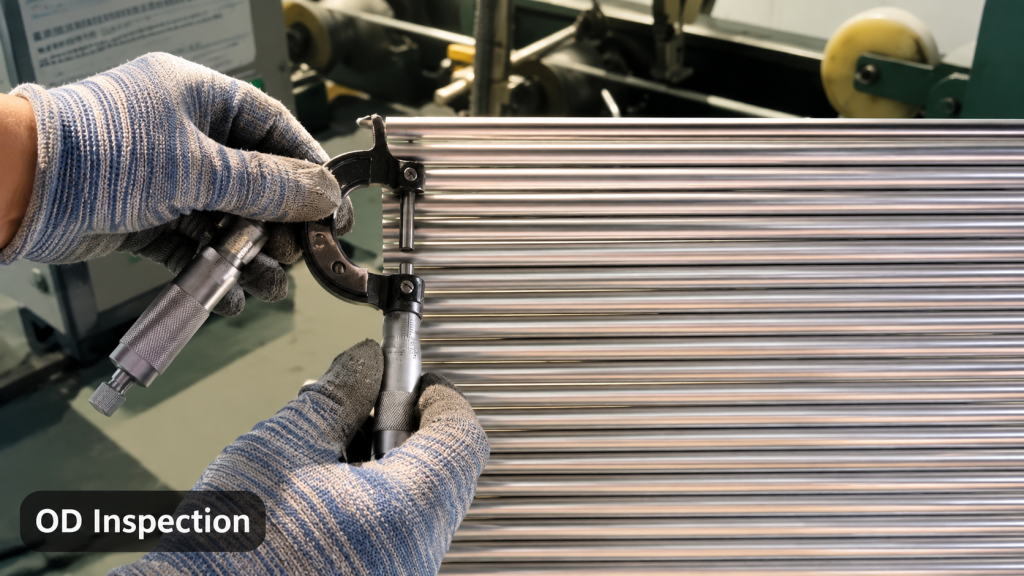
- OD and wall-thickness tolerance;
- ovality;
- elongation and ductility;
- weld seam consistency for welded tube;
- internal and external surface cleanliness;
- surface defects;
- straightness;
- length tolerance;
- eddy-current or other NDT requirements;
- pneumatic or hydrostatic testing where specified;
- lot traceability and MTC documentation.
For small-diameter, thin-wall heating element tubes, the difference between two suppliers can therefore be more than chemistry alone.
A tube that meets the alloy chemistry but performs poorly during reduction, bending or thermal cycling may still be unsuitable for the heater production line.
Welded or Seamless Tube?
There is no universal rule that every heating element tube should be seamless.
Alloy 840 itself is historically associated with seam-welded heating element sheath tubing, which demonstrates that a properly produced and qualified welded tube can be entirely appropriate for tubular heaters.
The buyer should instead review:
- heater type;
- wall thickness;
- reduction ratio;
- bending radius;
- thermal cycling;
- weld seam ductility;
- annealing condition;
- working medium;
- customer specification.
For particularly demanding forming routes, severe thermal cycling or customer requirements, seamless tube may still be reviewed.
The important question is therefore not simply:
“Is seamless better than welded?”
but:
“Which tube route has been qualified for this heater design and manufacturing process?”
Be Careful with ASTM Specifications
The alloy designation and the tube manufacturing standard are two different things.
For example, ASTM’s current nickel-alloy seamless tube framework includes ASTM B407 for nickel-iron-chromium seamless pipe and tube and ASTM B423 for UNS N08825 seamless pipe and tube. These are seamless product specifications and should not automatically be applied to a welded heating-element sheath product.
Alloy 840 is commonly identified by W.Nr. 1.4847 and may be purchased according to an agreed chemical, dimensional and heater-manufacturing specification.
A useful RFQ should therefore state separately:
- alloy / material designation;
- welded or seamless;
- applicable material standard if required;
- dimensional tolerance;
- heat treatment condition;
- inspection requirements.
What Should a Heating Element Buyer Provide Before Choosing 800, 840 or 825?
For a useful material and quotation review, provide as much of the following as possible:
- Heater type – tubular heater, immersion heater, cartridge heater or another design
- Heating medium – water, air, oil, steam, acid, alkaline solution or process liquid
- Normal and maximum medium temperature
- Maximum sheath temperature, if known
- Watt density
- Existing sheath material
- Existing failure mode, if this is a replacement project
- Tube OD × wall thickness × length
- Final heater diameter after reduction, if applicable
- Welded or seamless tube requirement
- Annealing condition
- Bend radius or forming route
- Water chemistry, acid concentration, chloride content or other relevant chemistry
- Required material designation or standard
- OD / WT tolerances
- NDT, pressure test or cleanliness requirement
- Required MTC / traceability
- Quantity and estimated annual consumption
For replacement projects, information about why the existing heater failed can be more useful than simply requesting a more highly alloyed tube.
Buyer Conclusion: 800, 840 and 825 Solve Different Problems
For heating element manufacturers, the three alloys can be viewed in a simple way:
Alloy 840:
Start here when the application is a conventional tubular heating element and a purpose-developed welded heater sheath alloy is appropriate.
Alloy 800:
Review it when elevated-temperature performance, oxidation resistance and a broader high-temperature material history are important.
Alloy 825:
Review it when corrosion of the heater sheath – particularly in certain chemical or acidic process media – becomes a major design driver.
The final decision should then be checked against:
working medium + actual sheath temperature + watt density + corrosion condition + tube manufacturing route + forming process + customer specification.
Selecting the correct alloy is important, but for tubular heater production the condition and consistency of the tube itself can be equally important.
FAQ
Can Incoloy 840 replace Incoloy 800 in heating elements?
Sometimes, but not automatically. Alloy 840 was specifically developed for welded electrical heating element sheath tubing and may be a practical option in many tubular heater designs. If the existing heater is qualified to UNS N08800, however, temperature, corrosion, forming behavior and validation requirements should be reviewed before changing material.
Is Incoloy 825 better than Incoloy 800 for heating elements?
Not in every heater. Alloy 825 is more strongly oriented toward corrosion resistance because of its nickel, molybdenum and copper alloying. Alloy 800 may be more appropriate when elevated-temperature and oxidation performance are the main requirements. The working medium and failure mechanism should determine which direction deserves review.
Why is Incoloy 840 commonly used for heating element tubes?
Alloy 840 was specifically developed as an Fe-Ni-Cr alloy for seam-welded tubing used as electrical heating element sheathing. This heater-specific design history is one reason it is commonly reviewed for tubular heating elements.
Is Incoloy 840 cheaper than Incoloy 800?
Its nominal nickel content is lower – approximately 20% versus about 30–35% for Alloy 800 – so its raw alloy cost exposure can be lower. Finished tube price, however, also depends on strip availability, diameter, wall thickness, quantity, processing, inspection and market conditions.
What is the maximum temperature for an Incoloy 800 heating element?
A single universal number should not be used. Published alloy temperature capabilities refer to particular material and equipment conditions, while actual heater-sheath temperature limits also depend on watt density, heat transfer, oxidation, cycling, wall thickness, scale and heater design. The heater manufacturer’s validated design limit and customer specification should govern.
Is Incoloy 800 the same as Incoloy 800H or 800HT?
No. N08800, N08810 and N08811 have different chemistry and grain-size controls. They should not be substituted for one another without confirming the heater specification and customer approval.
Should heating element tubes be welded or seamless?
Both routes can be considered depending on the alloy, heater design, reduction process, bending, thermal cycling and customer specification. Alloy 840 itself was developed for seam-welded heater sheath tubing. Seamless tube may be reviewed for particular demanding heater constructions or where the customer specification requires it.
When should Alloy 825 be considered for an immersion heater?
Alloy 825 may deserve review when corrosion of the heater sheath in a chemical or acidic process liquid is a primary concern. The exact acid, concentration, temperature, contaminants, chloride content and heater surface condition should be provided before material selection.
What information should I include in an RFQ for Incoloy heating element tubes?
At minimum, provide the alloy, OD, wall thickness, length, quantity and welded or seamless requirement. For a more useful technical review, also provide the heater type, heating medium, maximum temperature, watt density, bend or reduction requirements, existing failure mode and inspection requirements.