
01
Storage water heater elements
Consider water residence time, chloride-ion content, scale, sheath temperature, dry-firing events and the complete heater’s operating cycle.
A molybdenum-modified Cr–Ni stainless steel tube direction for water-contact tubular heating elements. Review the reference chemistry, welded-tube requirements and application-specific qualification before specifying the material.
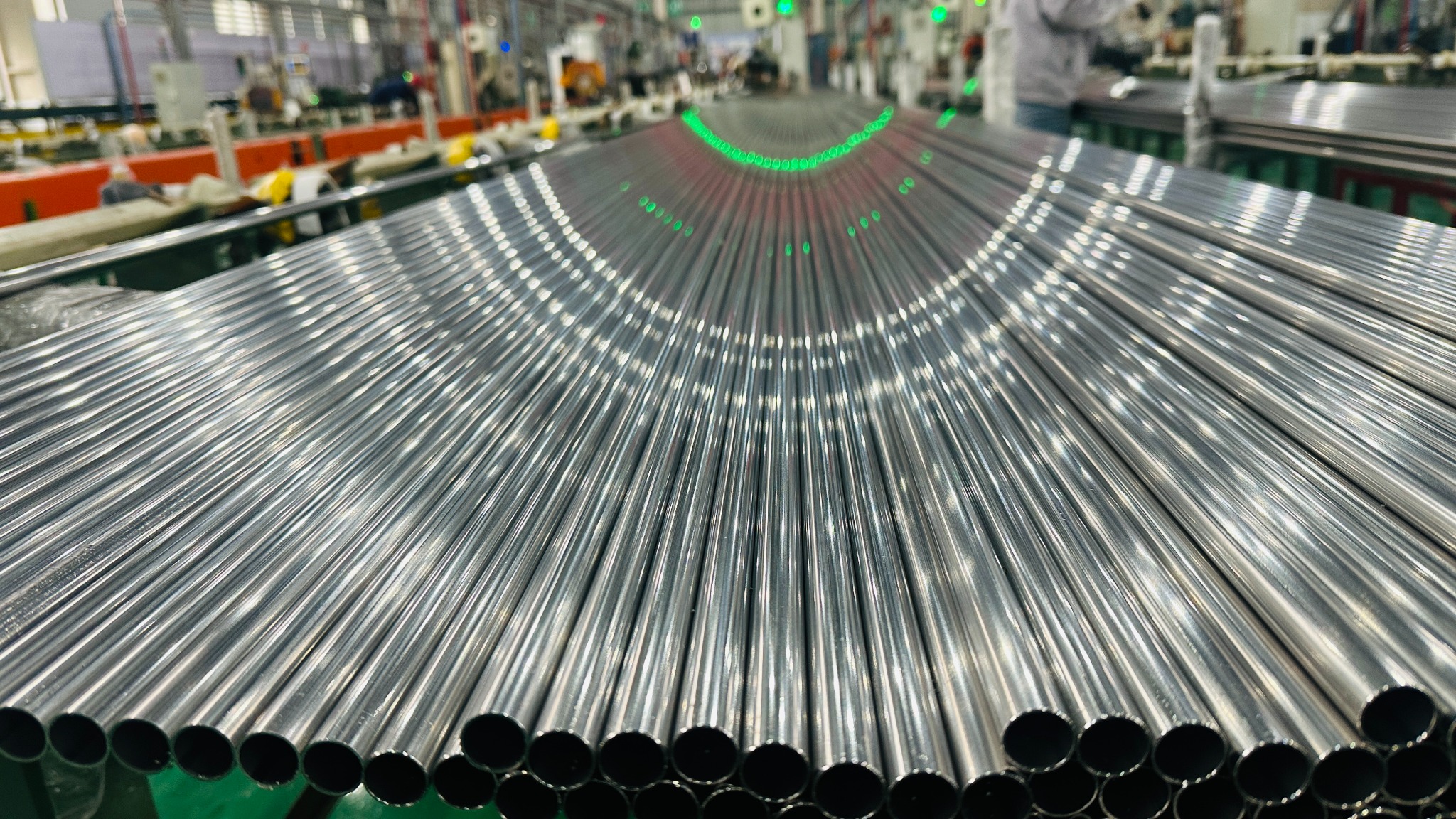
ESHR-03 is a project-specific designation for a molybdenum-alloyed chromium–nickel austenitic stainless steel being evaluated for tubular heater sheaths in water-contact service. It was previously described in some enquiries as 310S-Mo; it is not automatically equivalent to standardized 310S. Final acceptance depends on the agreed material chemistry and finished-tube specification.
Heating elements can encounter chloride ions in water, mineral deposits, local hot spots and repeated thermal cycling. ESHR-03 incorporates molybdenum as one alloy-design consideration for localized corrosion; the full heater still requires testing under its actual operating conditions.
The purchasable item is a finished heater sheath tube, not just an alloy name or a steel strip. Weld integrity, OD and wall control, annealing condition, surface quality and forming response need separate acceptance criteria.
These are reference limits from precursor-strip documentation, not an independently confirmed global grade standard. The purchase specification and batch certificate govern each order.
| Element | Reference wt.% | Selection relevance |
|---|---|---|
| Cr — Chromium | 23.0–25.0 | Contributes to passivation and oxidation-related alloy behavior. |
| Ni — Nickel | 17.0–19.5 | Contributes to the austenitic alloy system and fabrication response. |
| Mo — Molybdenum | 0.5–1.5 | Relevant to localized-corrosion behavior in suitable water environments. |
| C — Carbon | ≤ 0.06 | One consideration for processing and sensitization; not sufficient on its own to define weld behavior. |
One reference steel-strip batch was reported with tensile strength 644 MPa, 0.2% proof stress 316 MPa and A50 elongation 46%. These are batch observations on precursor strip, not guaranteed properties of the delivered welded tube and not proof of allowable wall-thickness reduction. Specify finished-tube tests separately where needed.
These materials serve different design objectives. The table explains what to evaluate; it is not a universal service-life ranking or an approval to substitute one grade for another.
| Material | Alloy / application direction | What the heater manufacturer should verify |
|---|---|---|
| ESHR-03 | Mo-modified Cr–Ni alloy intended for water-contact heater sheath review. | Agreed chemistry, chloride and deposit behavior, weld condition, forming and finished-heater qualification. |
| 310S | Established high-Cr / high-Ni heat-resistant stainless steel, often evaluated for oxidation-related requirements. | Actual sheath temperature, oxidation and water-side corrosion, if relevant. |
| Alloy 840 | Established heating-element alloy; chemistry and stabilized-alloy characteristics vary by applicable specification. | Relevant heater design, water chemistry, forming and the approved purchasing specification. |
| 316L | Conventional Mo-bearing stainless steel that may also be considered for water-contact heaters. | Water-side corrosion alongside actual heat exposure, fabrication and cost requirements. |
Important distinction: “Mo-modified” is not synonymous with “chloride-proof.” Water with chlorides, residual disinfectants, detergents and deposits presents distinct chemical conditions. Performance depends on concentration, pH, temperature, crevices and exposure time. PREN is a chemistry-based screening index, not a validated service-life prediction.
No. The project chemistry listed above is not automatically within standard 310S composition limits. “310S-Mo” is useful as a historical enquiry term, but engineering orders should state ESHR-03 and its agreed chemical limits explicitly. For more detail, read the material-selection article ↗.
Applications below identify review opportunities, not automatic approvals for a particular water, temperature or service life.
Consider water residence time, chloride-ion content, scale, sheath temperature, dry-firing events and the complete heater’s operating cycle.
Evaluate the real detergent chemistry, chloride content, cleaning cycles, crevice geometry, elevated water temperature and thermal cycling.
Review other water-contact tubular elements where specific corrosion conditions and manufacturing trials justify a tailored sheath grade.
Alloy selection, steel-strip values and finished-tube acceptance are separate steps. Supply form, sizes and inspection are determined by the accepted drawing or purchase specification.
Any wall reduction must be verified on the actual welded tube and complete heating element, including weld integrity, filling and compaction, bending, thermal cycling, corrosion margin and electrical-safety requirements. No general maximum service temperature or life guarantee is stated here.
Chloride ions, pH, hardness, detergent and deposits.
Sheath temperature, watt density, cycles and geometry.
OD × WT, weld condition, anneal, tests and forming.
Prototype testing and documented acceptance for the complete element.
Concise answers to common material, application and purchasing questions.
It is a project-specific Mo-modified Cr–Ni austenitic stainless steel tube direction for water-contact heating element sheaths. The chemical limits and finished-tube inspection requirements must be agreed for each order.
“310S-Mo” was an earlier enquiry name for this material direction, but ESHR-03 is not automatically a standard 310S grade. Orders must use the agreed ESHR-03 chemistry rather than assume conformity to the standard 310S limits.
Molybdenum is one alloy-design variable associated with localized-corrosion behavior in appropriate water environments. Its presence does not guarantee resistance to all chloride levels, crevice conditions, temperatures or cleaning chemicals.
No universal conclusion is justified. 316L also contains molybdenum. Compare the complete heater design, actual water, sheath temperature, fabrication and qualification results rather than element percentages alone.
No automatic substitution is claimed. Changes in chemistry can affect processing and service response. Confirm material acceptance, finished-tube manufacturing and application-level test results before changing an approved specification.
Yes, as a candidate for evaluation. Dishwashing detergents, chlorides, deposits and temperature cycles vary; corrosion and compatibility should be checked with the real medium and heating-element construction.
No universal maximum temperature, years of life or wall-reduction percentage can be inferred from the available reference strip data. These require relevant finished-tube and complete-heater qualification.
Provide OD, wall thickness, length or tube form, quantity, delivery condition, drawing, inspection requirements, application, water chemistry, sheath temperature and downstream operations such as bending or swaging.
Send your drawing or the basic technical parameters. GAOFA TECH can discuss material selection, tube specification and inspection requirements for your project.
Material: ESHR-03 / other grade for comparison Tube: Welded / other form for review OD × WT × Length: Quantity: Application / heater type: Water chemistry (Cl⁻, pH, hardness, detergent): Operating / maximum sheath temperature: Bending / swaging / filling process: Delivery condition / tolerances: Inspection / material certificate / packing:The text can also be selected and copied manually.
Technical note: the material composition shown is a project reference; final acceptance criteria, production feasibility and application suitability require a confirmed specification and representative validation. Technical reading: a related Mo-modified stainless steel study, not a certification of ESHR-03.