A heating-element manufacturer may ask a practical purchasing question: can straight Incoloy 800 or Incoloy 840 tube be replaced by a long coil? The alloy grade may remain the same, but the incoming tube condition presented to the heater production line may not.
For both Incoloy 800 tube and Incoloy 840 tube, the useful question is not only whether coil supply is technically possible. The buyer should determine whether the tube can be coiled, transported, uncoiled and straightened while still meeting the required OD, roundness, straightness, surface and forming condition for the downstream heater process.
Incoloy 800 / UNS N08800
Alloy 800 may be supplied as welded or seamless tube depending on the project. For heater applications, incoming tube condition, annealing, dimensional control and downstream forming should be reviewed together.
Incoloy 840 / UNS S33400 / 1.4847
Alloy 840 is strongly associated with welded electrical heating-element sheath tubing. GAOFA TECH’s current Alloy 840 supply direction is welded tube, so seam condition and annealing are part of the coil-versus-straight review.
Can Coiled Incoloy 800 or 840 Tube Replace Straight Tube?
Sometimes, yes—but only after the final usable tube condition is defined. A coil and a straight tube can have the same alloy chemistry and nominal OD × wall thickness, yet still behave differently on a heater production line because the coil has experienced additional curvature and must usually be straightened before processing.
This is why coil supply should be treated as a manufacturing-route change, not merely a packing change. The same principle applies whether the buyer is using Alloy 800 or Alloy 840 for tubular heaters, water-heating elements, appliance heaters or other heating element tube applications.
OD, wall, roundness, hardness, annealing condition, weld condition where applicable and surface establish the starting point.
The tube is forced into curvature. Tensile and compressive strains develop across the section and springback follows unloading.
The coil is opened for processing. Handling, guide equipment and coil diameter influence the condition entering the straightener.
The centerline is corrected, but the previous forming history is not automatically erased from the tube geometry or mechanical condition.
Important: not every commercial coil is made by taking finished straight lengths and winding them into a coil. Tube may be produced continuously in coil form, annealed before or after particular forming stages, or processed through another mill route. Buyers should therefore ask where final annealing occurs in the manufacturing sequence, not only whether the shipment is labelled “coil” or “straight.”
What Actually Changes After Bending and Straightening?
| Item | Straight-Length Tube | Coiled + Re-Straightened Tube | Why a Heater Manufacturer May Care |
|---|---|---|---|
| Alloy chemistry | Defined by the specified heat and material grade. | Can remain exactly the same Alloy 800 or Alloy 840 chemistry. | Coiling does not itself change one alloy into another; the concern is the final physical and mechanical condition. |
| Straightness | Final straightness is controlled in the straight-length condition. | Depends on uncoiling, straightener design, roll setting and cut length. | Automatic cutting, filling and long heater assemblies may require repeatable straightness. |
| Roundness / ovality | Measured in the final delivered straight condition. | Bending and straightening can introduce or retain cross-sectional ovality. | Roundness can influence guides, filling, swaging, reduction and final dimensional consistency. |
| OD consistency | Controlled after the normal straight-tube finishing route. | Maximum and minimum OD readings may differ locally because of ovality or straightening pressure. | Thin-wall heater tube often works within a narrow tooling window. |
| Wall / cross-section | No additional coiling strain after final straight finishing. | The outside of a bend is mainly in tension and the inside mainly in compression; severity rises as bend radius becomes tighter. | Thin wall and high OD/WT ratios are generally more sensitive to section distortion. |
| Cold work / hardness | Depends on the mill route and final heat treatment. | Additional cold deformation can change the local mechanical condition if it is not followed by an appropriate anneal. | Later reduction, swaging or bending can be sensitive to ductility and hardness. |
| Residual stress | Still depends on the original manufacturing history. | Coiling and re-straightening add another deformation history and can change residual-stress distribution. | More relevant when downstream forming is demanding or the heater design already operates near a validated process limit. |
| Surface condition | Reflects the normal tube production and straight-length handling route. | Extra guide and straightener contact can add roll or handling marks if control is poor. | Surface requirements may matter for forming, sealing, appearance or customer inspection. |
The table does not mean coil supply is automatically unsuitable. With a generous coil diameter, suitable annealed tube condition and controlled straightening equipment, the final straightened tube may still meet the customer’s requirements. The key is to inspect the tube after the actual uncoiling and straightening process.
Why Thin-Wall Heating Element Tubes Are More Sensitive
Heating-element sheath tubes are often small in diameter and relatively thin in wall. They are also rarely the finished component. The tube becomes input material for additional operations, so a small incoming dimensional change can appear again later in the heater line.
- Cutting and positioning: poor straightness can affect feed systems, guides and automated cut-length control.
- Resistance wire and MgO filling: stable ID geometry, roundness, cleanliness and dryness support repeatable filling conditions.
- Swaging / reduction: dimensional variation, hardness and weld condition where applicable can influence reduction consistency.
- Final bending: the heater may be bent again after reduction, adding another forming stage to the tube’s previous manufacturing history.
- Qualification: an existing heater line may already have approved process settings based on a known straight-tube condition.
This is also why tube form should not be evaluated separately from the manufacturing route. Our seamless vs welded tube selection guide makes the same point: welded and seamless tube are not ranked simply as “good” or “bad”; suitability depends on material, annealing, dimensions, weld quality, forming requirements and customer approval.
Incoloy 800 vs Incoloy 840: Does the Coil Question Change?
The basic bending and straightening mechanics apply to both materials, but the commercial tube route may differ. That distinction matters when the heater manufacturer reviews coil feasibility.
| Review Point | Incoloy 800 | Incoloy 840 |
|---|---|---|
| Material designation | UNS N08800 for Alloy 800. | UNS S33400 / 1.4847 for Alloy 840. |
| Heater use direction | Commonly reviewed for heating elements and higher-temperature / oxidation-related applications, depending on design and medium. | Strongly associated with seam-welded electrical heating-element sheath tubing and appliance / water-heating applications. |
| Tube route | Welded or seamless may be reviewed depending on project and specification. | GAOFA TECH’s current supply direction is welded Alloy 840 tube. |
| Coil review | Confirm final annealing, coil diameter, straightening method, straightness, roundness, OD and downstream forming. | Confirm the same items, with additional attention to welded seam condition and the heater manufacturer’s reduction / bending route. |
| Material substitution | Changing 800 to 840 is a separate material-selection decision. It should not be mixed with the straight-versus-coil decision. See Incoloy 800 vs 840 vs 825 for Heating Elements for the material comparison. | |
Two different questions should stay separate: “Can we change from straight length to coil?” is a supply-form and fabrication question. “Can we change from Incoloy 800 to Incoloy 840?” is a material-selection and qualification question. A project can involve one change without the other.
Does Re-Straightening Restore the Original Straight-Tube Condition?
Not automatically. A straightener can correct the tube centerline so that a previously curved tube becomes usable as a straight length. But centerline straightness is only one property.
Centerline Curvature
With suitable straightening equipment and settings, the tube can be brought back within a defined straightness requirement for cutting and heater assembly.
Final Tube Condition
Roundness, maximum/minimum OD, local cold work, residual stress, surface marks and weld condition where applicable should be reviewed after straightening.
For Alloy 800, published fabrication guidance confirms that the alloy is cold formable and work-hardens during cold deformation. More generally, thin-wall tube bending and straightening research shows that residual cross-sectional ovality can remain after straightening. The practical conclusion for heater buyers is therefore straightforward: measure the final re-straightened tube rather than assuming it has returned to the original straight-tube state.
When Can Coil Supply Be a Practical Option?
Coil supply deserves review when it provides a real production or logistics advantage and the customer has a controlled uncoiling / straightening process. Typical situations include:
- high-volume heater production using automated tube feeding;
- a long required tube length that is inconvenient to ship or handle as straight lengths;
- the customer already processes similar thin-wall tube from coil;
- a sufficiently large coil diameter can be used relative to tube OD and wall;
- the final straightness, OD and ovality can be checked after straightening;
- the customer can run a representative heater production trial before bulk approval.
When Is Straight-Length Supply the Lower-Risk Starting Point?
Straight-length tube may remain the more practical starting condition when:
- straightness or roundness tolerance is tight;
- the tube is very thin-wall relative to OD;
- the heater uses substantial later swaging or reduction;
- the customer does not have a controlled tube straightening line;
- the existing heater has already been qualified using straight tube;
- changing the incoming tube form would require process or end-customer revalidation.
In these cases, changing to coil only to reduce freight or packing length can introduce a new process variable without enough manufacturing benefit.
Why “Can You Supply 500 ft Coils?” Is Not Enough for an RFQ
A customer may ask only whether 500 ft coils are possible. Coil length matters commercially, but it does not describe the deformation severity. A 500 ft coil wound to a generous diameter can be less demanding than a much shorter coil wound tightly.
| Buyer Input | Why It Matters |
|---|---|
| Material grade | Confirm Incoloy 800 / UNS N08800 or Incoloy 840 / UNS S33400 rather than using “Incoloy” alone. |
| Welded or seamless | The available manufacturing route and forming behavior should match the approved heater design. |
| OD × wall thickness | Controls flexibility, ovality sensitivity and straightening setup. |
| Required coil length | Defines production and handling needs, but does not define curvature by itself. |
| Minimum coil ID / target coil OD | Coil diameter is directly related to how severe the curvature is. |
| Final cut length | Helps determine whether coil supply creates a meaningful production advantage. |
| Final straightness / OD / ovality | Defines what the re-straightened tube must actually achieve. |
| Annealing / hardness requirement | Clarifies the required metallurgical condition before filling and reduction. |
| Downstream heater process | Filling, swaging, reduction ratio and final bending determine how sensitive the line is to incoming tube condition. |
Practical decision rule
Do not ask only whether Incoloy 800 or 840 can be made in coil form. Ask whether the tube can be coiled, uncoiled and straightened and still meet the final dimensional, mechanical and fabrication requirements of the actual heater production line.
What Should Be Checked in a Coil Trial?
Before changing a regular straight-length supply to coil, a representative trial is more useful than a theoretical yes/no answer. Depending on the drawing and customer specification, review:
- coil ID / OD and winding condition;
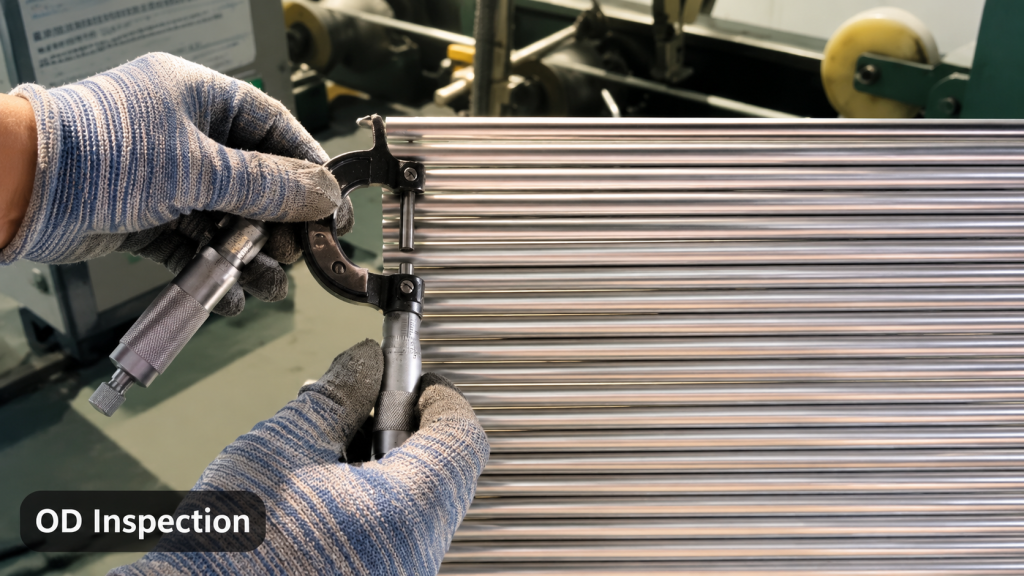
- tube OD and wall thickness before and after straightening;
- maximum and minimum OD and resulting ovality after straightening;
- straightness over the customer’s actual cut length;
- surface condition after uncoiling and roll straightening;
- hardness or mechanical properties when specified;
- weld seam condition for welded Incoloy 800 or 840 tube;
- internal cleanliness, dryness and end protection when required;
- behavior during the customer’s normal filling and swaging / reduction process;
- behavior during final heater bending and qualification.
The acceptance criteria should come from the heater drawing, purchase specification and validated production process. For broader grade-selection questions—including whether 304, 321, 310S, Incoloy 800 or 840 should be reviewed—see our Heating Element Sheath Material Selection Guide.
Buyer Conclusion: Coil Is a Supply-Form Change, Not Just a Packing Change
For Incoloy 800 and Incoloy 840 heating-element tubes, changing from straight lengths to coil does not necessarily change the alloy chemistry. What can change is the forming history and the tube condition presented to the heater production line.
The most useful buyer questions are therefore:
- What is the tube OD × wall and how large is the proposed coil diameter?
- Is the tube welded or seamless, and what is the weld condition where applicable?
- Where does final annealing occur in the manufacturing sequence?
- How will the customer uncoil and straighten the tube?
- What straightness, OD and ovality must be achieved afterward?
- Will the re-straightened tube still run consistently through filling, reduction and final heater bending?
If these points are controlled and validated, coil can be a practical supply option. If they are unknown, straight and coiled tube should not be treated as automatically interchangeable simply because both carry the same Incoloy 800 or Incoloy 840 grade designation.
Copyable RFQ Template – Straight or Coiled Incoloy 800 / 840 Tube
Send the tube requirement together with the intended supply form and downstream heater process so feasibility can be reviewed against the actual application.
Material Grade: Incoloy 800 / UNS N08800 OR Incoloy 840 / UNS S33400
Tube Type: Welded / Seamless
Supply Form: Straight Length / Coil
OD × Wall: ___ × ___ mm
Straight Length or Coil Length: ___
Minimum Coil ID / Target Coil OD: ___
Quantity: ___
Annealing / Hardness Requirement: ___
Straightness Requirement After Uncoiling: ___
OD / Ovality Tolerance After Straightening: ___
Downstream Process: Filling / Swaging / Reduction / Bending / Other
Application: Tubular Heater / Cartridge Heater / Water Heater / Appliance Heater / Other
Standard / Drawing: ___
FAQ
Can straight Incoloy 800 tube be replaced directly by coil?
Sometimes, but not automatically. Confirm the coil diameter, manufacturing route, final annealing condition, uncoiling / straightening method and the final straightness, OD, ovality, surface and forming requirements of the heater line.
Can straight Incoloy 840 tube be replaced by coil?
It can be reviewed, but the final re-straightened tube should meet the heater manufacturer’s dimensional and forming requirements. Because Alloy 840 is commonly used as welded heating-element sheath tube, weld condition, annealing, reduction and final bending should be included in the validation.
Does coiling change Incoloy 800 or 840 chemical composition?
No. Mechanical bending does not by itself change the alloy chemistry. The concern is the additional forming history and its possible effect on geometry, cold work, residual stress, surface condition and downstream fabrication.
Will bending and straightening make the tube harder?
Cold deformation can change the local mechanical condition. The amount depends on material, tube geometry, coil radius, straightening severity and whether an anneal follows. Where hardness or ductility is important to swaging, reduction or bending, confirm the final delivered condition rather than assuming it is unchanged.
Can straightening completely remove ovality from a coiled thin-wall tube?
Not necessarily. A straightener can correct centerline curvature, but some cross-sectional ovality may remain. Final maximum/minimum OD and roundness should be measured after the actual straightening route when those dimensions matter to heater manufacturing.
Does a 500 ft coil cause more deformation than a shorter coil?
Not necessarily. Coil length is mainly a production and logistics parameter. Coil diameter, tube OD, wall thickness, material condition and straightening method are more directly related to deformation severity.
Will coiling and re-straightening directly change heater electrical resistance?
It should not be stated as a universal direct effect. Finished heater resistance is mainly determined by the resistance wire and heater design. The practical concern is that tube dimensional or mechanical variation may affect filling, reduction, tooling and process consistency, so the coil route should be validated on the actual heater line.
What should a heating-element manufacturer test before approving coil supply?
Check the tube after uncoiling and straightening: straightness, maximum/minimum OD, ovality, surface condition and any specified hardness or mechanical requirements. Then run representative tube through the normal filling, swaging / reduction and final bending process before bulk approval.