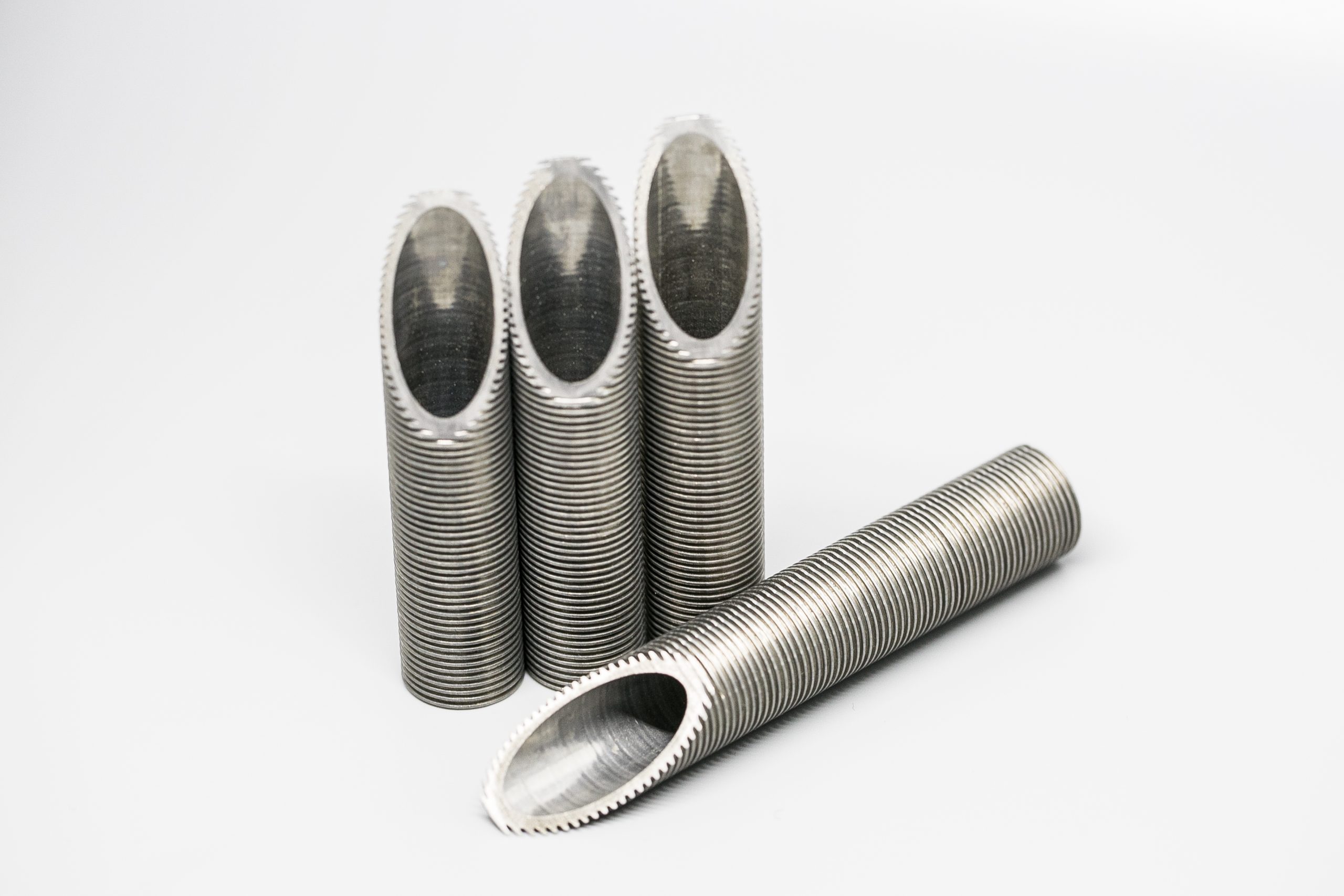
A request for “low fin tube, Ø19.05 × 1.0 mm, length 6,000 mm” describes a starting tube size—but not the finished fin profile. For an integral low fin tube, a few additional dimensions can make the difference between a preliminary inquiry and a geometry that can be reviewed for production.
Quick RFQ reference
Specify the tube, the fins and the ends.
Include material, base tube size, OD over fins, root diameter, fin height, FPI or pitch, total length, plain ends, quantity and application. A drawing is the clearest way to confirm how these dimensions relate.
What to Include in a Low Fin Tube RFQ
These are the main details needed to identify the finished tube—not just its starting size.
| RFQ item | What to specify |
|---|---|
| Material & tube form | Material grade, required specification and welded or seamless parent tube, if specified. |
| Outside diameter (OD) | Identify the parent/plain-end OD and the finished OD over fin tips. Do not treat them as the same dimension. |
| Wall thickness | Starting tube wall; specify minimum remaining wall at the fin root separately when required. |
| Root diameter & fin height | Diameter at the fin roots and radial height from root to fin tip. |
| Fin density | Fins per inch (FPI) or pitch in mm, plus fin thickness/profile if controlled by the drawing. |
| Total length & plain ends | Overall length, finned length, plain-end length at each end and transition details; state if full-length finning is needed. |
| Quantity, service & drawing | Required quantity, equipment/application and working media. Include a drawing, sketch or existing tube reference if available. |
Three Details That Often Delay Quotation
These are easy to overlook when an RFQ starts from a smooth-tube specification.
Which outside diameter?
“Ø19.05 mm” might mean the parent tube, plain end or finished fin-tip OD. The difference matters for bundle clearance and tube-sheet fit.
Which wall thickness?
Integral fins are formed from the tube material. Starting wall thickness should not be assumed to equal the minimum finished wall at the root.
How long are the plain ends?
Tube-sheet expansion, rolling, welding or sealing may require defined unfinned lengths. The two ends may differ, or full-length finning may be requested.
Geometry before performance
More fins do not automatically mean more heat transfer.
Confirm fin-tip OD, root diameter, fin height, pitch and finned length before comparing surface area. Even with a defined profile, actual duty depends on fluids, flow, the controlling thermal resistance, fin efficiency, fouling and allowable pressure drop.
A Simple Low Fin Tube RFQ Format
Buyers can send the information already available. A complete thermal calculation is not needed for the first inquiry.
Material GradeGrade / standard if required
Tube FormWelded / Seamless / To be reviewed
Base TubeOD × Wall Thickness
Fin GeometryOD over fins / Root Ø / Height / FPI or pitch
LengthsTotal / Finned / Plain ends (both sides)
QuantityPieces or total requirement
Application & Working MediaEquipment / Fluids
Drawing / Sample ReferenceIf available
If the complete fin profile is not yet available, an existing tube drawing, sketch or sample reference can support an initial feasibility review. Final dimensions, tolerances and inspection requirements still need agreement before order confirmation.
Have a tube drawing or sample reference?
GAOFA TECH can review your specified geometry and coordinate suitable tube supply options for your project.