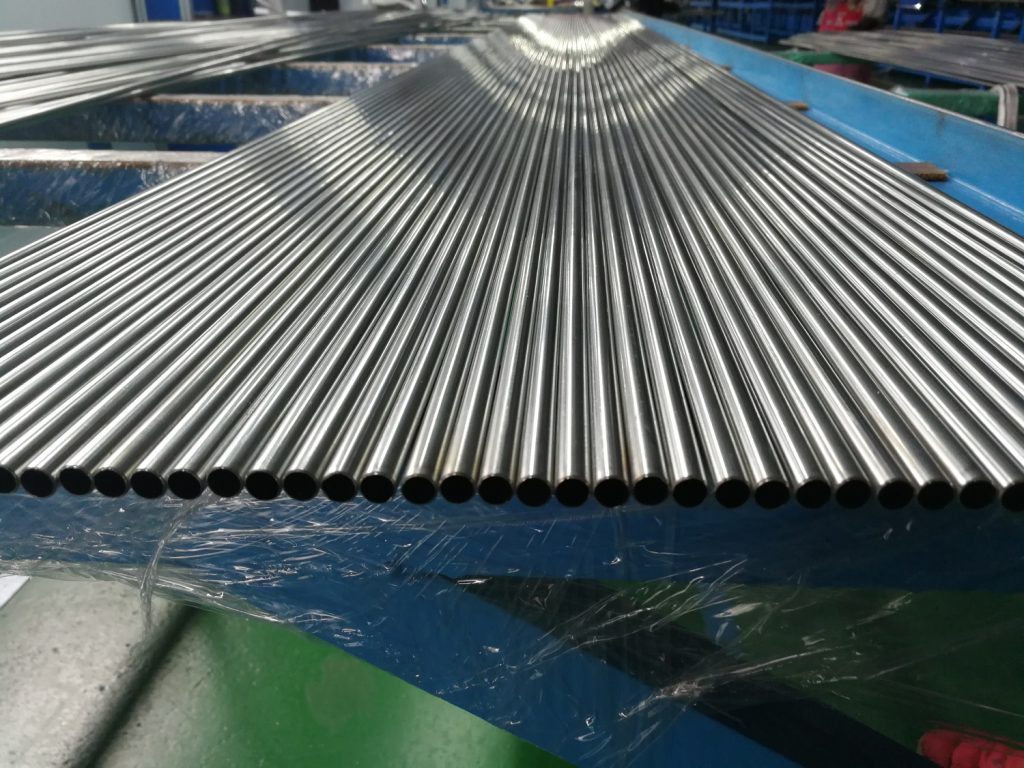

Yes. Stainless steel tubes can be considered as an alternative to copper tubes in some heat exchangers, condensers, evaporators and refrigeration equipment, but they are not a direct drop-in replacement.
Copper and stainless steel differ in thermal conductivity, mechanical properties, corrosion behavior, thermal expansion and fabrication characteristics. A material change may therefore require review of tube wall thickness, heat transfer area, flow conditions, pressure drop, tube sheet connection and equipment validation.
For a buyer considering stainless steel because of copper price pressure, corrosion problems or a new equipment design, the more useful question is not simply:
“Can stainless steel replace copper?”
It is:
“Can a stainless steel tube design meet the required heat transfer, corrosion, mechanical and fabrication requirements of this heat exchanger?”
For a broader review of stainless steel, titanium, nickel alloy and enhanced tube alternatives, see our Copper Tube Replacement Review.
Why Are Heat Exchanger Manufacturers Reviewing Alternatives to Copper Tubes?
Copper and copper alloys continue to be used in many heat transfer applications because of their thermal properties and established manufacturing processes.
However, equipment manufacturers may review alternative tube materials when they face:
- copper price pressure or cost volatility;
- corrosion or premature tube failure;
- changes in cooling water, refrigerant, brine or process medium;
- different pressure or mechanical requirements;
- equipment redesign or new product development;
- supply-chain considerations;
- requirements for different corrosion resistance or expected service life.
The reason for the material review matters.
If the main issue is price, the thermal and fabrication consequences still need to be evaluated. If the existing copper tube has failed, the failure mechanism should ideally be understood before another material is selected.
Copper vs Stainless Steel Heat Exchanger Tubes
Changing from copper to stainless steel affects more than the tube material itself.
| Review Factor | Copper Tube | Stainless Steel Tube | What Should Be Reviewed |
|---|---|---|---|
| Thermal conductivity | High | Lower than copper | Heat transfer area, wall thickness and overall thermal design |
| Mechanical properties | Depends on copper grade and temper | Different strength and wall design possibilities | Pressure, tube wall and applicable design requirements |
| Corrosion behavior | Depends on copper alloy and medium | Strongly dependent on stainless grade and service environment | Water chemistry, chlorides, temperature, pH and deposits |
| Wall thickness | Based on the existing copper design | A different thickness may be considered | Pressure, fabrication, corrosion and specification |
| Joining | Brazing, expansion and other established methods may be used | Welding and expansion behavior are different | Tube sheet and tube-to-tube-sheet design |
| Heat transfer enhancement | Smooth and enhanced copper tubes are available | Smooth, low fin and inner grooved stainless tubes can also be reviewed | Heat transfer, pressure drop, fouling and cleaning |
| Cost comparison | Sensitive to copper material cost | Different raw material and processing structure | Total equipment cost rather than tube price alone |
A copper-to-stainless project should therefore be treated as an engineering review rather than a simple purchasing substitution.
1. Heat Transfer Performance Must Be Reviewed
One of the most important differences between copper and austenitic stainless steel is thermal conductivity.
Copper transfers heat through the tube wall more readily than stainless steel. This does not automatically mean stainless steel cannot be used, but it does mean that an existing copper tube design should not simply be copied without thermal review.
Depending on the equipment, the designer may need to consider:
- required heat duty;
- overall heat transfer coefficient;
- tube OD and wall thickness;
- tube length;
- total heat transfer area;
- number of tubes;
- fluid velocity;
- pressure drop;
- fouling factor;
- tube surface geometry.
Tube-wall conductivity is also only one part of the total thermal resistance.
Fluid-side heat transfer, fouling, wall thickness, flow conditions and exchanger geometry all contribute to actual equipment performance.
This is why comparing copper and stainless steel only by material thermal conductivity does not provide a complete answer.
2. Can a Thinner Stainless Steel Tube Wall Be Used?
This is a common question in copper replacement projects.
A buyer may currently use a copper tube with a certain OD and wall thickness and ask whether the same dimensions should simply be changed to 304 or 316L stainless steel.
That is not necessarily the correct approach.
Because stainless steel has different mechanical properties, wall thickness can be one of the variables reviewed during redesign.
A thinner wall reduces the conduction distance through the tube wall, but it should not be assumed that reducing stainless steel wall thickness will automatically compensate for the difference in material thermal conductivity.
The selected wall thickness must still satisfy:
- design pressure;
- applicable standard or equipment code;
- tube expansion or welding requirements;
- vibration and fatigue conditions;
- corrosion allowance if required;
- manufacturing and handling requirements;
- dimensional tolerances;
- customer specification.
In short:
Wall thickness may be optimized, but it should be calculated rather than guessed.
3. Should 304 or 316L Be Considered?
304 and 316L are common starting materials when buyers first investigate stainless steel tubes for heat exchanger applications.
However, the correct stainless steel grade should be selected according to the actual working environment.
304 Stainless Steel
304 may be reviewed for selected heat exchanger and cooling applications where the working medium and corrosion conditions are suitable.
Important factors include:
- chloride concentration;
- operating temperature;
- pH;
- water treatment;
- stagnant areas;
- deposits and fouling;
- cleaning chemicals;
- welding and fabrication conditions.
316L Stainless Steel
316L contains molybdenum and is commonly reviewed when higher localized corrosion resistance is required compared with standard 304.
It may be a useful starting direction for selected cooling-water, condensate and process heat exchanger applications.
However:
316L should not be treated as a universal solution for seawater or every high-chloride service condition.
Pitting, crevice corrosion and stress corrosion cracking can still become important depending on chloride level, temperature, deposits, stagnant conditions, residual stress and equipment design.
For seawater, chloride-rich cooling water or more aggressive environments, titanium tubes or another corrosion-resistant material direction should also be evaluated.
4. What If the Existing Copper Tubes Failed by Corrosion?
If the replacement project starts because existing copper tubes have failed, material selection should begin with the failure condition rather than simply selecting a different alloy.
Useful information includes:
- tube-side and shell-side media;
- chloride concentration;
- pH;
- operating temperature;
- dissolved oxygen if relevant;
- ammonia, sulfides or other aggressive components if relevant;
- suspended solids;
- water-treatment chemicals;
- flow velocity;
- stagnant areas;
- deposits and scale;
- cleaning chemicals;
- location and appearance of tube damage.
A tube damaged primarily by water chemistry requires a different review from a tube damaged by vibration, excessive velocity, tube-sheet conditions or mechanical wear.
Where possible, photographs of the failed tube and service information can be useful during the initial material review.
5. Tube Sheet Material and Joining Method Also Matter
The tube is only one part of a shell-and-tube heat exchanger.
When changing from copper or copper alloy to stainless steel, the equipment manufacturer should also review the tube-to-tube-sheet connection.
Questions may include:
- What is the tube sheet material?
- Are the tubes mechanically expanded?
- Are the tubes welded?
- Is brazing used in the existing design?
- Is expansion combined with welding?
- Does the new material combination introduce galvanic concerns?
- Are the existing tube-hole dimensions suitable?
- Are different expansion parameters required?
- Could differences in thermal expansion affect the connection?
This is particularly important in retubing and replacement bundle projects, where the original equipment may have been designed specifically around copper or copper-alloy tubing.
A successful material change therefore requires both tube material review and connection design review.
6. Can Enhanced Stainless Steel Tubes Help?
In some redesigned heat exchangers, enhanced tube geometry may also be considered.
Examples include:
- low fin tubes, which increase external surface area;
- inner grooved tubes, which modify the internal surface and flow behavior;
- other enhanced tube geometries developed for particular condenser, evaporator or heat exchanger designs.
These options may be useful when heat transfer area, equipment size or thermal performance is being reconsidered.
However, an enhanced stainless steel tube should not be presented as an automatic way to compensate for the lower thermal conductivity of stainless steel.
The designer still needs to evaluate:
- heat transfer coefficient;
- allowable pressure drop;
- flow behavior;
- fouling tendency;
- cleaning accessibility;
- fin or groove geometry;
- remaining wall thickness;
- tube expansion;
- equipment manufacturing process.
Enhanced tubes are therefore design options, not universal copper-replacement solutions.
7. When Is Stainless Steel Worth Reviewing as a Copper Alternative?
The following table can be used as an initial screening guide.
| Buyer Situation | Initial Review Direction |
|---|---|
| Copper price pressure | Stainless steel may be evaluated if the thermal design can be reviewed |
| New heat exchanger design | A good opportunity to compare different tube materials and geometries |
| Existing copper tube corrosion | Identify the failure mechanism before selecting stainless steel, titanium or another material |
| Controlled cooling-water service | 304 or 316L may be reviewed according to actual chemistry and temperature |
| Higher corrosion requirement | 316L or another stainless grade may be reviewed depending on service conditions |
| Seawater or high-chloride cooling water | Titanium or another corrosion-resistant material direction should also be evaluated |
| Higher pressure or mechanical requirement | Stainless steel may offer different wall and mechanical design possibilities |
| Need for enhanced heat transfer surface | Low fin or inner grooved stainless tubes may be evaluated |
| Existing equipment designed specifically for copper | Thermal design, tube sheet and joining method require particular attention |
When May Stainless Steel Not Be a Good Direct Replacement?
Additional caution is required when:
- the heat exchanger has very limited thermal design margin;
- a one-for-one tube replacement is required without thermal recalculation;
- the service environment creates unacceptable stainless steel corrosion risk;
- the production process is highly dependent on copper-specific brazing or forming;
- the existing tube sheet or joining process is incompatible with the new material;
- the equipment owner or applicable specification does not approve the material change;
- the existing copper failure mechanism has not been identified.
In these cases, another stainless steel grade, titanium, nickel alloy or continued use of an appropriate copper alloy may be a more suitable direction.
Compare the Complete Heat Exchanger, Not Only Tube Price per Kilogram
A common purchasing comparison is:
Copper tube price per kilogram vs stainless steel tube price per kilogram.
For a replacement project, this is incomplete.
Changing material can also affect:
- tube weight;
- tube wall thickness;
- required heat transfer area;
- number of tubes;
- tube manufacturing cost;
- heat exchanger dimensions;
- tube-sheet fabrication;
- joining method;
- inspection and testing;
- maintenance requirements;
- expected service conditions.
Copper replacement is therefore better reviewed at the heat exchanger, tube bundle or project level, rather than by tube material price alone.
For broader tube options used in shell-and-tube equipment, see our Heat Exchanger Tubes application page.
Copper-to-Stainless Heat Exchanger Tube Review Checklist
For an initial copper replacement review, the following information is useful:
- Existing copper or copper-alloy grade, if known
- Existing tube OD × wall thickness × length
- Smooth, finned, internally grooved or other tube geometry
- Heat exchanger, condenser or evaporator type
- Tube-side working medium
- Shell-side working medium
- Operating temperature and pressure
- Flow rate or velocity, if available
- Required heat duty or existing thermal data
- Water chemistry and chloride level, if relevant
- Reason for replacement: price, corrosion, failure or redesign
- Photographs of existing tube damage, if applicable
- Tube sheet material
- Expansion, welding, brazing or other joining method
- Cleaning method and fouling condition
- Proposed stainless steel grade, if already specified
- Applicable material standard or customer specification
- Inspection and testing requirements
- Quantity or estimated annual demand
- Delivery destination and required schedule
If the replacement material has not yet been finalized, providing the existing operating conditions and tube information first is often more useful than specifying 304 or 316L without the service details.
FAQ
Can stainless steel tubes directly replace copper tubes in a heat exchanger?
Not necessarily. Stainless steel tubes can be considered in selected heat exchangers, condensers, evaporators and refrigeration equipment, but heat transfer, wall thickness, corrosion, pressure, tube sheet design, fabrication and customer approval should be reviewed before replacement.
Does stainless steel transfer less heat than copper?
Yes. Austenitic stainless steel has substantially lower thermal conductivity than copper. However, actual heat exchanger performance also depends on wall thickness, fluid-side heat transfer, surface area, flow conditions, fouling and the overall exchanger design.
Can thinner stainless steel tube walls compensate for lower thermal conductivity?
A thinner wall reduces conduction resistance through the tube wall and may be one parameter considered during redesign. It should not be assumed to fully compensate for the material difference. Pressure, corrosion, fabrication, vibration and specification requirements must also be satisfied.
Is 316L better than 304 for replacing copper tubes?
316L is commonly reviewed where greater corrosion resistance is required compared with standard 304, but its suitability still depends on chloride concentration, temperature, pH, crevice conditions, deposits and the complete service environment.
Is 316L suitable for seawater heat exchangers?
It should not be assumed to be suitable simply because it is 316L. Seawater and high-chloride applications require careful evaluation of localized corrosion risk, temperature, flow, crevices and equipment design. Titanium or another corrosion-resistant material direction may be more appropriate in some projects.
Can stainless steel tubes be used in condensers and evaporators?
Yes, stainless steel tubes are used in selected condenser, evaporator, refrigeration and heat exchanger designs. The appropriate grade, tube form and wall thickness depend on the working media, temperature, pressure, corrosion conditions, heat transfer requirement and equipment specification.
Can low fin or inner grooved stainless steel tubes help in a copper replacement project?
They may be considered when additional surface area or another heat transfer enhancement approach is required. Their use should still be evaluated for heat transfer, pressure drop, fouling, cleaning, wall thickness and fabrication.
When should titanium be considered instead of stainless steel?
Titanium should also be reviewed when seawater, chloride-rich cooling water, brine or another corrosive medium creates unacceptable risk for the proposed stainless steel grade. Final selection depends on the actual medium, temperature, pressure, flow condition, tube sheet design and customer specification.